
Floor Grinding
When Do You Actually Need Floor Grinding on a Concrete Floor? Grinding is used when parts of the floor won’t come up clean — thick coatings, uneven repairs, or areas that are sitting higher than the rest. Floor grinding across Meath and the north-east Grinding usually comes into it when a floor isn’t sitting right. […]
Get a free quote
Our Clients





When Do You Actually Need Floor Grinding on a Concrete Floor?
Grinding is used when parts of the floor won’t come up clean — thick coatings, uneven repairs, or areas that are sitting higher than the rest.
Floor grinding across Meath and the north-east
Grinding usually comes into it when a floor isn’t sitting right.
You’ll see patches where repairs were done and left slightly proud of the slab. Old epoxy still stuck in places, but gone in others. Grinder marks from previous prep attempts. Transitions between old and newer concrete that don’t match.
Loading lanes can be the worst for it — patched, worn, built up over time.
Start working into it and you realise it’s not a flat surface at all.
Where grinding is needed
Not always the full floor.
More often it’s areas that are causing problems:
- thick coatings that won’t lift clean
- high spots from old repairs
- rough sections where concrete has broken up
- patches that were levelled at different times
- adhesive or old material that’s bonded in
Some of it comes away easily. Other parts fight you the whole way.
What’s involved when grinding a floor
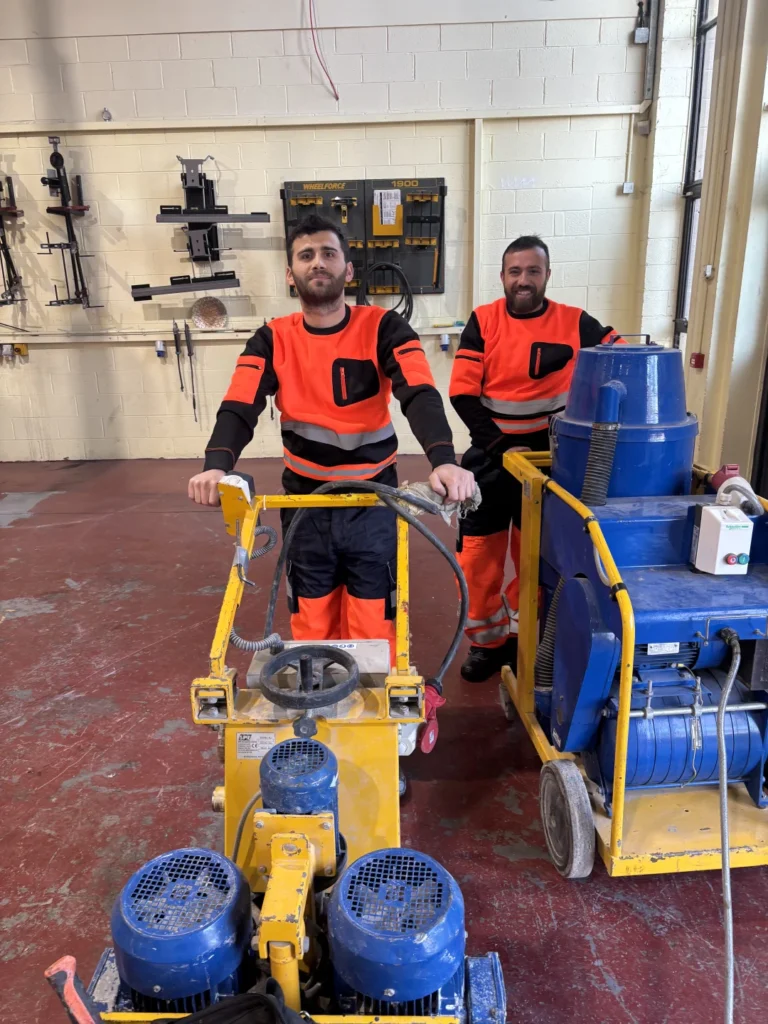
Machines run over the surface and start cutting into it.
Diamond heads wear differently depending on the slab — some areas chew through them faster than others. On rough sections, the machine pulls harder. You feel it straight away.
Old coatings can clog things up too, especially thicker epoxy.
Edges and corners always take longer. That’s just the way it is — they need to be done with smaller hand grinders.
When it comes up on a job
Usually after a floor has been looked at properly.
Blasting might take care of the general surface, but once you hit heavier areas, it’s not enough.
That’s where grinding comes in first.
A lot of older floors end up needing both grinding and blasting to get them right.
The kind of floors we grind
You get all sorts.
Warehouse floors with patched loading areas. Units where coatings have been added over the years. Sections where repairs don’t line up with the rest of the slab.
Some parts come back clean. Others just keep exposing more underneath once you start.
Grinding compared to shot blasting
Grinding is heavier work.
It’ll deal with things blasting won’t touch — thick coatings, uneven repairs, stubborn patches.
Blasting is better once the floor is already in decent condition.
Trying to blast a floor that really needs grinding first usually wastes time.
Getting the work done
Grinding isn’t a quiet job.
Machines running, vibration through the slab, extraction hoses running constantly to keep dust under control.
Stubborn areas often need a few passes. In tighter spaces, work has to be broken up and done in sections.
Meath Floor Painting Company
Get a quote for floor grinding in Meath
If parts of your floor are uneven, built up or not coming clean, grinding is usually part of sorting it out.
We cover Meath, Louth, Cavan and Monaghan.
Get in touch and we’ll take a look.
Get a free quote
Your solution starts here. Get a quote!
Related Flooring Solutions
A Reliable Industrial Flooring Service
At Meath Floor Painting Company, we turn up when agreed, carry out the work properly, and leave behind a floor that holds up.
Get a free quote
Clear communication, proper prep, and a finish that doesn’t need to be redone a few months later.